Venezuela impulsa el desarrollo del atletismo con seminario técnico en el estado Bolívar
Más de 160 participantes y representantes de 47 clubes asistieron a una jornada de formación
Más de 160 participantes y representantes de 47 clubes asistieron a una jornada de formación


Always your country first

By Sabrina Padrón. Editor and International Analyst on Human Rights – Oscar Blue Ramírez News
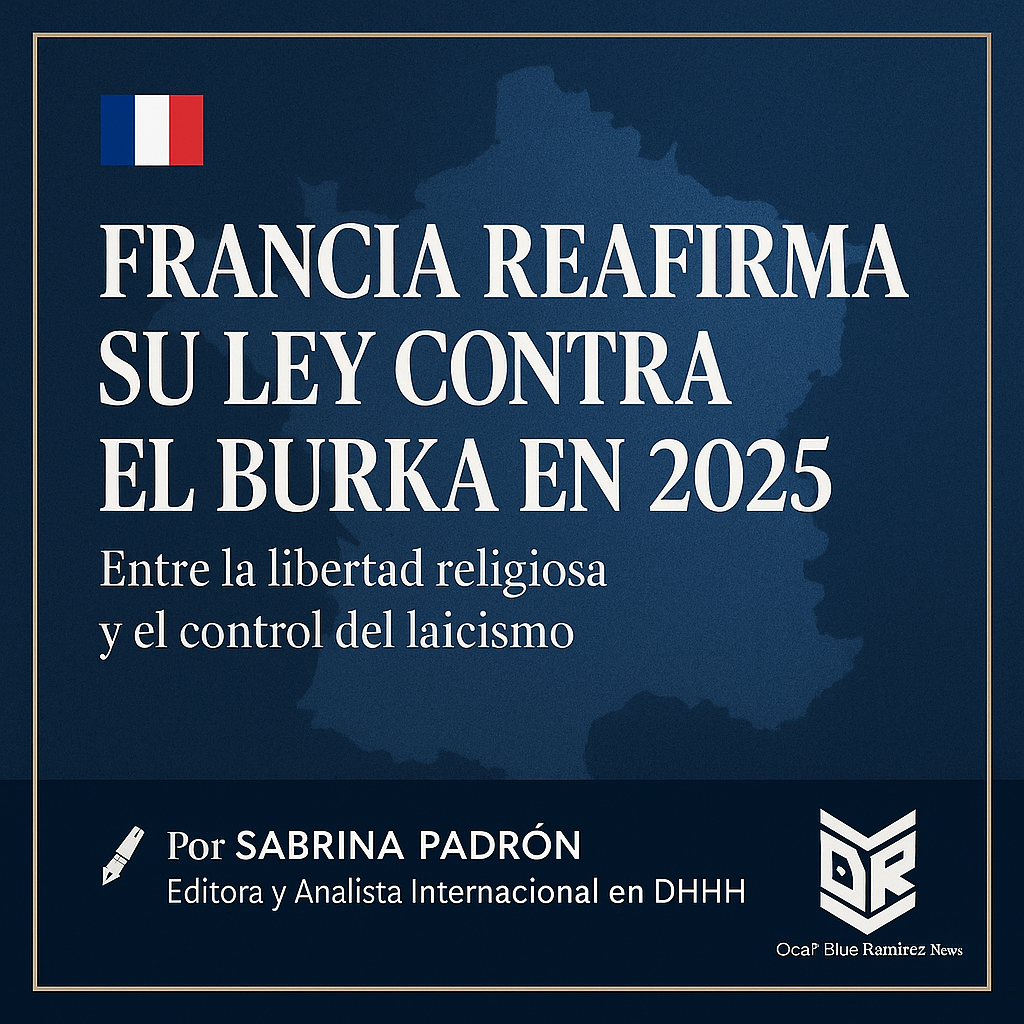
In 2025, France once again makes international headlines after reaffirming the validity and scope of Law No. 2010-1192, which prohibits covering the face in public spaces. Enacted in 2010 and implemented since 2011, the measure – known as the “burqa law” – has become a of the most controversial regulations in contemporary Europe.
The French government, headed by Emmanuel Macron, has reiterated that the norm “will not be repealed”, despite pressure from international organizations that denounce an increase in Islamophobic sentiment and an erosion of the right to freedom of religion.
“France is a secular republic. Religion belongs to the private sphere; equality before the law should not depend on the veil or faith,” Interior Minister Géraldine Chastel recently stated, in statements reported by Le Monde.
Since its entry into force, the French authorities have registered more than 3,700 sanctions for non-compliance with the rule, according to the latest report of the Conseil d’État (2025). 87% of the cases were single sanctions, and less than 10% corresponded to recidivism.
Although the number of violations is low compared to the6 million Muslims who live in France (8.8% of the population), the debate transcends numbers: the State considers that the full veil contradicts republican values, while the organizations Human rights classify it as a symbolic limitation on personal identity.
A study by the Observatoire de laïcité (2024) revealed that 56% of French people support maintaining the law, but 38% believe it reinforces stigmas against the Muslim community.
France is the country with the largest Muslim population in Western Europe and the strictest in terms of secularism.
The Separation of Church and State Act of 1905 established a key principle: the neutrality of the State towards all religions. However, this secularism—originally designed to guarantee freedom—has been transformed, in some cases, into a tool of social and political control.
In 2025, the French government is considering expanding legislation to prohibit the use of the hijab in official sports competitions and by girls under 15 years of age, which has sparked protests in Paris and Marseille. The measure is part of the so-called National Integration Plan, whose objective is to “strengthen cultural cohesion,” although critics warn that it deepens the marginalization of religious minorities.
“Religious freedom cannot fragment the Republic, but it cannot be censored by it either,” declared Amira Djabali, president of the Islamic Council of Women of France.
Since 2010, Belgium, Denmark, Austria, Bulgaria and Switzerland have followed the French example, implementing similar restrictions. The phenomenon has been described by the European Policy Center as a“domino effect of identity secularism”, where security policies are confused with assimilation mechanisms cultural.
The Fundamental Rights Agency of the European Union (FRA) warned in its 2025 report that stigmatization for religious reasons increased by 23% in the last five years, mainly affecting Muslim women and young migrants.
The French case highlights a dilemma that extends beyond religion: the struggle to define what it means to be a citizen in a plural society.
As an international Human Rights analyst, I observe that France does not face a crisis of faith, but rather a crisis of coexistence and recognition. When the State seeks to protect its identity through prohibition, it runs the risk of building unity through exclusion.
Europe’s challenge in 2025 is not only to maintain security, but to preserve the freedom to be different without being singled out for it.
✍️ Editor and International Human Rights Analyst: Sabrina Padrón
📱 @sabrinavisualmedia. X: @sabripadron. 🌐 oscarblueramirez.com