In the world of Latin American television, few names inspire as much respect and affection as that of Juan Carlos Troncoso, a screenwriter who has dedicated his life to telling stories that touch the soul. A disciple of the unforgettable Fernando Gaitán, creator of “Yo soy Betty, la fea” (Ugly Betty), Troncoso has been the mind behind productions that have resonated with millions of viewers in Colombia and around the world.
Oscar “Blue” Ramirez
Journalist and international correspondent
Oscar Ramírez is a Mexican journalist from Tijuana, Baja California, graduated in Communication and radio announcer.
Recognized for his experience in international migration issues, he has traveled and documented all the borders of northern Mexico with the United States. In the south of the country, he has walked and registered more than 12 migrant caravans, in addition to documenting the route of the Central American Triangle and crossing the dangerous Darién jungle on four occasions, between Panama and Colombia - one of the deadliest routes in the world for migrants.
As a war correspondent, he has covered international conflicts in Ukraine (border with Russia) and in the Middle East, reporting from Israel with the borders of Gaza, Lebanon and Syria.
Currently, Oscar Ramírez works as a bilingual correspondent for various media and is part of the international team of Real America's Voice News, a recognized media in the United States.
In 2023, he was awarded at the Congress of Colombia with the Diana Turbay Award, one of the most important journalistic recognitions in the country, for its coverage and documentation of the migratory route through the Darién jungle.
Beyond his informative work, Oscar Ramírez has distinguished himself for his humanitarian journalism, focused on giving voice and face to the stories of migrants and communities affected by violence and international conflicts.
By Sabrina Padrón Special for Oscar Blu Ramírez News 📅 October 16, 2025
⸻
🇮🇹 A bill that reopens the debate on freedom and faith in Europe
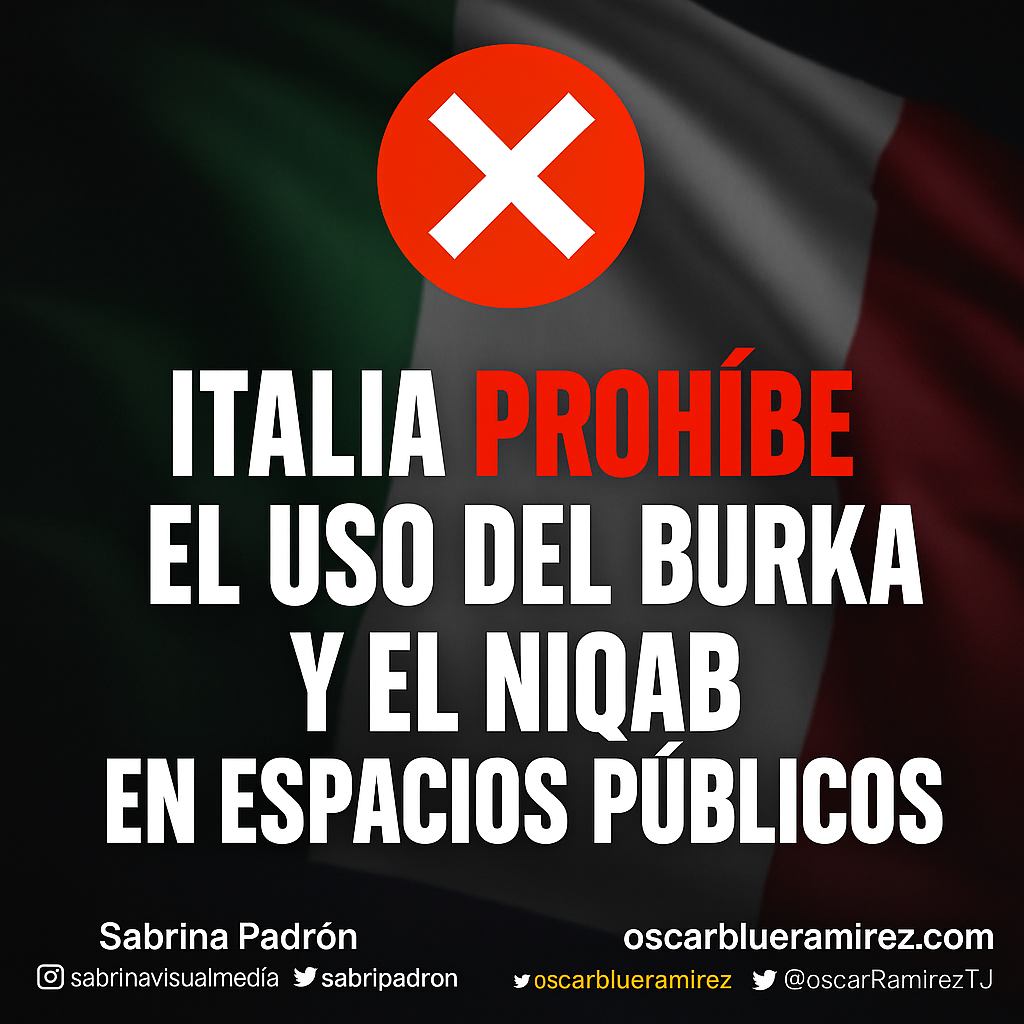
Italy is experiencing a new social and political controversy today following the presentation of the bill promoted by Prime Minister Giorgia Meloni, which seeks to ban the wearing of the burqa and niqab in public places. The measure, promoted by her Brothers of Italy (Fratelli d’Italia) party, aims to strengthen security Citizenship and “Italian cultural identity,” but it has sparked a wave of criticism for its impact on religious freedom and individual rights.
The text proposes fines of 300 to 3,000 euros for those who fully cover their faces in public spaces, and includes a package of reforms that controls the funding of religious communities and toughens penalties for forced marriages and virginity tests.
Although the government maintains that it is “a rule of safety and respect for women,” several social organizations denounce that the proposal unfairly associates Islam with a lack of integration, fueling prejudices and further dividing Italian society.
⸻
⚖️ Between security and freedom of worship
This bill isn’t starting from scratch: Italian law has prohibited covering the face in public without a justified reason since 1975. However, Meloni’s initiative introduces a specifically religious component, which many consider an attempt at cultural control rather than a security policy.
Human rights groups and Muslim associations claim that the law stigmatizes women and limits their right to decide about their identity and religious expression. On the contrary, Meloni’s supporters maintain that “no woman should be forced to hide her face for cultural reasons.” or religious.”
“It’s not about faith, but about dignity and visibility,” declared MP Carolina Varchi, one of the proponents of the text.
⸻
🌍 A discussion that transcends borders
The Italian proposal joins a debate that has already taken place in countries such as France, Belgium, and Austria, where the use of the full-face veil is restricted in public spaces. However, in Italy the issue touches particularly sensitive nerves: a country where millions of Muslim immigrants live together, and where religious identity is an essential part of the fabric social.
The Italian Parliament will discuss the initiative in the coming weeks. If approved, it would be one of the most controversial laws of the Meloni era and could set a new precedent on the balance between individual freedom, security, and religious coexistence in Europe.
⸻
🕊️ Final reflection
Beyond the political debate, this project reveals a deep tension between the need for security and respect for diversity. Prohibiting it may seem like a control measure; However, when public policies forget empathy, they end up alienating rather than integrating.
In times when the world is fragmenting due to cultural differences, Italy faces the challenge of deciding whether to govern from fear or from inclusion.
⸻
📍 Editor: Sabrina Padrón – @sabrinavisualmedia x @sabripadron / for Oscar Blu Ramírez News 📎 Sources: El País, Reuters, Swissinfo, Financial Times, BBC Mundo